The journey usually moves through four broad stages:
That means a growing restaurant brand needs more than a strong concept.
It needs:
- Healthy unit economics
- A clearly defined customer proposition
- A repeatable operating model
- Site-selection criteria
- Capital planning
- A scalable design system
- Reliable procurement and manufacturing
- A predictable project-delivery process
- A way to learn from each new outlet
Expansion becomes easier when the brand knows not only where it wants to grow, but also what must be true before each new location is approved.
Expansion Starts Before the Second Outlet
A restaurant should not expand simply because the first location is popular.
Before committing to another site, the brand should understand whether the first outlet has produced a model that can be repeated.
Questions to answer include:
- Is the customer proposition clear?
- Are sales patterns understood?
- Does the menu work operationally?
- Is the kitchen workflow efficient?
- Are staffing requirements predictable?
- Is the outlet financially viable?
- Which design elements matter most to the brand?
- Which operational problems appeared after opening?
- What would need to change in outlet two?
The purpose of the first outlet is therefore not only to generate revenue.
It is also to generate evidence.
1. Prove the Unit Economics
Restaurant expansion should be based on a working economic model.
Before scaling, brands should understand key outlet-level metrics such as:
- Sales
- Average transaction value
- Food cost
- Labour cost
- Occupancy cost
- Contribution margin
- Capex
- Payback expectations
- Delivery vs dine-in mix
- Peak-hour throughput
The exact metrics will vary by restaurant format.
The important point is that a chain should know what a viable outlet looks like before trying to replicate one.
A restaurant that is visually successful but financially weak is not yet a scalable model.
2. Define the Expansion Thesis
A restaurant chain should be clear about why and where it is expanding.
Expansion can follow different strategies.
For example:
City Deepening
Opening more outlets within a city where the brand already has awareness, supply relationships and operating knowledge.
New-City Expansion
Entering a new market once the brand has enough confidence in its format and operating model.
Cluster Expansion
Opening several locations within a defined geography so operations, supervision, supply and marketing can support multiple units efficiently.
Format Expansion
Using more than one format, such as:
- Full dine-in restaurants
- Compact QSRs
- Mall units
- Food-court outlets
- Airport locations
- Kiosks
- Delivery-led formats
The right model depends on the brand, customer behaviour and economics.
Expansion should therefore begin with a market thesis, not simply with an available property.
3. Build Clear Site-Selection Criteria
As chains grow, site selection should become more systematic.
Instead of asking whether a location “feels good,” define the conditions that make a site suitable.
Criteria may include:
- Catchment
- Footfall
- Visibility
- Access
- Parking
- Delivery demand
- Competition
- Rental economics
- Floor area
- Frontage
- Electrical capacity
- Exhaust possibilities
- Drainage
- Landlord restrictions
- Loading access
- Target customer density
This helps the brand compare sites using a repeatable framework.
It also reduces the risk of forcing the concept into locations that cannot support the required kitchen, customer flow or operating model.
4. Create Site Archetypes
One of the most useful ways to scale is to stop designing around one ideal property.
Instead, restaurant chains can define a small number of site archetypes.
For example:
High-Street Format
Designed around street frontage, direct customer access and local catchment.
Mall Format
Designed around mall services, landlord guidelines, common-area visibility and controlled working conditions.
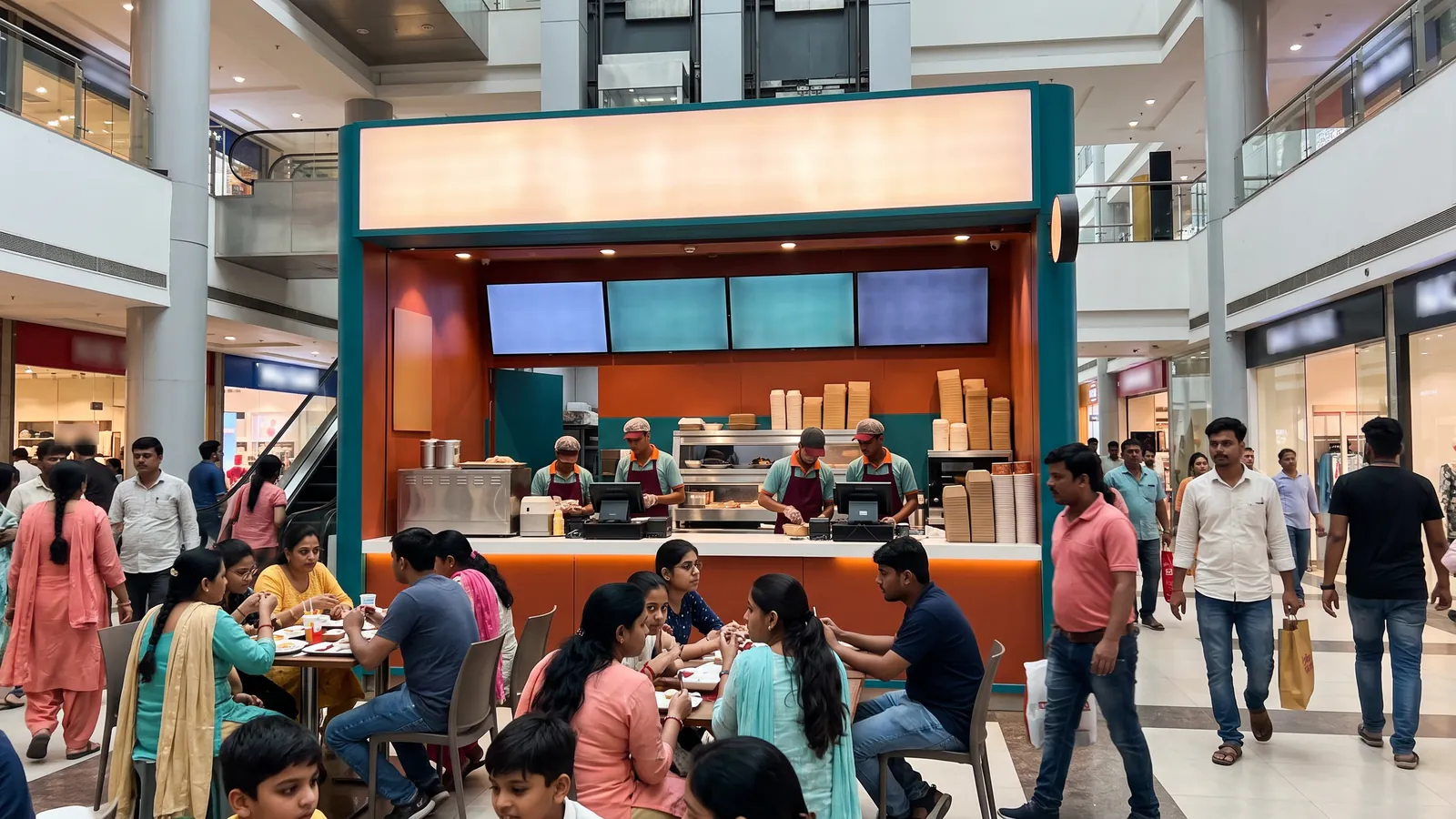
Food-Court Format
Focused on service speed, counter visibility, compact kitchens and shared seating environments.
Airport / Transit Format
Designed around compact footprints, high footfall, restricted access and fast customer decisions.
Flagship Format
A larger expression of the brand that may contain more custom experiences and customer-facing features.
A brand that understands its site archetypes can adapt faster than one trying to force a single prototype into every location.
5. Learn From the First Few Outlets
The second and third outlets are especially valuable because they reveal which parts of the original restaurant genuinely repeat well.
For example:
A counter detail may look good but be difficult to maintain.
A seating type may reduce flexibility.
A material may not be available consistently.
A kitchen layout may work well in one footprint but poorly in another.
A signage detail may need better visibility.
These are not failures.
They are information.
Growing brands should capture these lessons and update future locations.
A scalable restaurant system should therefore become better with every outlet, not simply more repetitive.
6. Separate Brand Rules From Site Decisions
Restaurant chains need consistency, but consistency does not mean copying every detail.
A useful expansion model distinguishes between:
Brand-Critical Elements
These are the elements customers should recognise across locations.
Examples may include:
- Brand colours
- Signage
- Service-counter language
- Signature materials
- Furniture character
- Lighting principles
- Graphic identity
Site-Responsive Elements
These should respond to the property.
Examples may include:
- Seating quantity
- Kitchen configuration
- Ceiling treatment
- Service routing
- HVAC
- Exhaust
- Façade conditions
- Structural constraints
This allows the brand to stay recognisable without forcing one floor plan everywhere.
For a deeper breakdown of what should repeat and what should remain flexible, see how to open multiple restaurant outlets without starting from scratch.
7. Build an Expansion Pipeline, Not One Project at a Time
A growing restaurant chain should think in terms of a pipeline.
At any point, different outlets may be in different stages:
This changes the management challenge.
Instead of focusing only on one construction site, the brand needs visibility across the entire portfolio.
Useful questions include:
- Which sites are under evaluation?
- Which leases are close to approval?
- Which outlets are in design?
- Which projects are waiting for landlord approval?
- Which long-lead items need to be ordered?
- Which outlets can open in the same rollout wave?
- Where are decisions blocking progress?
A pipeline view helps management allocate capital, people and suppliers more intelligently.

8. Expand in Waves
Opening ten restaurants does not necessarily mean starting all ten at once.
Many brands benefit from a phased approach.
For example:
Wave 1
Launch a small number of locations using the updated prototype.
Review
Measure:
- Cost
- Programme
- Operational performance
- Customer response
- Design issues
- Procurement problems
Wave 2
Apply what was learned and open the next group.
This creates a balance between speed and learning.
Expansion becomes a controlled sequence rather than one large uncontrolled commitment.
9. Plan Capital Across the Portfolio
Each new restaurant requires capital before it generates revenue.
Growing chains therefore need to plan not only the capex of one outlet, but the cash requirements of the entire expansion programme.
The portfolio may include:
- Deposits
- Design fees
- Fit-out
- Kitchen equipment
- Furniture
- Signage
- Technology
- Pre-opening expenses
- Hiring
- Marketing
- Working capital
If several outlets overlap, those cash requirements can also overlap.
This is why expansion pace should match the brand’s capital capacity and operating support.
Fast expansion without financial control can create pressure long before the restaurants mature.
10. Create a Repeatable Delivery Model
Once a brand is opening several outlets, project delivery itself needs to become scalable.
Instead of selecting a completely new process for every site, the chain can establish a consistent sequence for:
- Site feasibility
- Design
- Technical coordination
- Approvals
- Procurement
- Manufacturing
- Site execution
- Quality checks
- Handover
This is where an integrated Restaurant Design & Build system can become valuable.
FlatPackCo’s Restaurant Design & Build platform connects:
so future projects can follow a clearer delivery framework rather than being rebuilt as unrelated one-off projects.
Explore Restaurant Design & Build Services.
11. Build Operational Capacity Alongside Physical Expansion
Restaurant expansion is not only a construction challenge.
Every new location also increases demand on:
- Operations
- Hiring
- Training
- Supply chain
- Maintenance
- Finance
- Marketing
- Technology
- Area management
- Quality assurance
The physical rollout and the operating organisation need to grow together.
Opening sites faster than the business can train teams or maintain standards can weaken the customer experience even if the construction programme is successful.
A strong expansion strategy therefore asks:
Can the organisation operate the next outlet as well as it can build it?
12. Use Data From Every New Location
Each outlet should improve the expansion model.
Useful information may include:
- Cost per location
- Build duration
- Variation orders
- Maintenance issues
- Kitchen bottlenecks
- Customer dwell time
- Seating performance
- Delivery volume
- Equipment failures
- Material durability
- Opening delays
These insights can be fed back into:
- Site criteria
- Design standards
- Procurement
- Manufacturing
- Operations
- Future budgets
The result is a restaurant chain that becomes more predictable as it grows.
13. Know When to Localise
A chain needs a recognisable brand, but not every location should ignore its context.
Local adaptation may be useful where it improves:
- Customer relevance
- Site fit
- Climate response
- Material availability
- Façade integration
- Seating mix
The key is controlled localisation.
The brand should know which elements are flexible before the project begins.
That prevents every site team from independently deciding what can change.
14. Prepare for Multi-City Expansion
Expanding into another city adds another layer of complexity.
The brand may need to consider:
- Different landlords
- Local consultants
- Material availability
- Labour conditions
- Logistics
- Vendor coverage
- Travel
- Local management
- Maintenance response
A repeatable design and manufacturing system can reduce some of that variability, but local conditions still matter. FlatPackCo delivers projects across India, including restaurant fit-outs in Mumbai and Bengaluru.
The strongest multi-city expansion model combines central standards with local execution intelligence.
15. Decide What Should Stay Centralised
As the chain grows, some decisions are better controlled centrally.
These may include:
- Brand design
- Key materials
- Counter standards
- Furniture specifications
- Kitchen criteria
- Signage
- Technology
- Approved suppliers
- Quality benchmarks
Other decisions can sit closer to the local project.
This creates a clearer governance model and reduces unnecessary decision-making at each site.
For brands building this system, see our restaurant rollout guide.
How Design & Build Supports Restaurant Expansion
Restaurant chains need to repeat projects without creating unnecessary duplication.
An integrated Design & Build approach can support expansion by connecting:
- Design
- Engineering
- Procurement
- Manufacturing
- Execution
Once a successful outlet has been tested, suitable information can carry into future projects.
The advantage is not that every outlet becomes identical.
The advantage is that future teams begin with a tested system instead of a blank page.
FlatPackCo describes this broader progression as:
This creates a bridge between delivering one restaurant and building a scalable network. FlatPackCo has delivered multiple outlets for The Croffle Guys, and offers turnkey restaurant delivery for brands that want one partner from design to handover.
What Is the Difference Between Expansion Strategy and Restaurant Rollout?
The two are related but not identical.
Restaurant Expansion Strategy
Answers questions such as:
- Why should we expand?
- Which markets should we enter?
- What formats should we use?
- How quickly should we grow?
- How should capital be allocated?
- What organisation is required?
Restaurant Rollout
Focuses more on the physical delivery of multiple locations:
- Design standards
- Engineering
- Materials
- Procurement
- Manufacturing
- Execution
- Quality control
Expansion strategy decides where and how the business grows.
Rollout systems help the brand deliver the physical outlets consistently.
For the detailed delivery side, see the Restaurant Rollout Guide.
Frequently Asked Questions
How do restaurant chains expand?
Restaurant chains expand by proving a successful operating model, selecting suitable markets and sites, developing repeatable formats, building an outlet pipeline and improving the system as each new restaurant opens.
When should a restaurant open a second location?
A second location should usually be considered once the first restaurant has enough operating and financial evidence to show that the concept can work beyond one site. The decision should consider unit economics, management capacity, customer demand and capital.
What should a restaurant standardise before expansion?
Brands often standardise customer-facing brand elements, materials, furniture families, counters, signage, kitchen criteria, technical standards and quality benchmarks while allowing site-specific elements to adapt.
Should restaurant chains use the same layout everywhere?
No. Site dimensions, services, structure and landlord requirements vary. A chain should maintain its brand principles while adapting the layout and technical solution to each property.
What is a restaurant expansion pipeline?
An expansion pipeline is the portfolio of future restaurant locations moving through stages such as site search, feasibility, lease approval, design, procurement, construction and handover.
Is it better to expand into many cities or deepen one market first?
There is no universal answer. City deepening can simplify management and logistics, while new-city expansion can access new customers. The choice depends on demand, economics, operating capability and brand strategy.
How do QSR chains expand faster?
QSR chains can reduce repeated work by using defined site criteria, repeatable service counters, kitchen standards, furniture specifications, approved materials and coordinated Design & Build processes.
What is a restaurant rollout wave?
A rollout wave is a group of outlets developed within a planned phase. Brands can review cost, programme and operational lessons from one wave before releasing the next.
How does site selection affect restaurant expansion?
Site selection determines rent, visibility, customer access, kitchen feasibility, technical requirements and potential sales. Poor site choices cannot usually be solved by interior design alone.
Why do restaurant chains create different store formats?
Different formats allow the brand to operate in different types of locations such as malls, high streets, airports, food courts or smaller catchments while maintaining the core customer proposition.
How can restaurant chains maintain quality while expanding?
Quality can be supported through clear design and technical standards, approved materials, controlled manufacturing, quality benchmarks, consistent project governance and feedback from completed outlets.
How does Design & Build help restaurant chains expand?
Design & Build can connect design, engineering, procurement, manufacturing and execution within one delivery framework, reducing repeated coordination and helping future locations start from tested information.
What is the difference between restaurant expansion and restaurant rollout?
Expansion is the broader business-growth strategy covering markets, sites, capital, formats and organisational capacity. Rollout is the system used to physically deliver multiple restaurant locations.
Can a small restaurant brand use an expansion strategy?
Yes. Even a brand planning its second or third outlet can benefit from defining site criteria, documenting lessons, planning capital and identifying what should repeat before growth accelerates.
Final Takeaway
Restaurant chains do not scale simply by opening more locations.
They scale by building a system that makes each new outlet easier to evaluate, design, deliver and operate.
That system connects:
The first outlet proves the idea.
The next few outlets prove whether the idea can travel.
A true restaurant chain emerges when growth becomes repeatable without becoming rigid.